
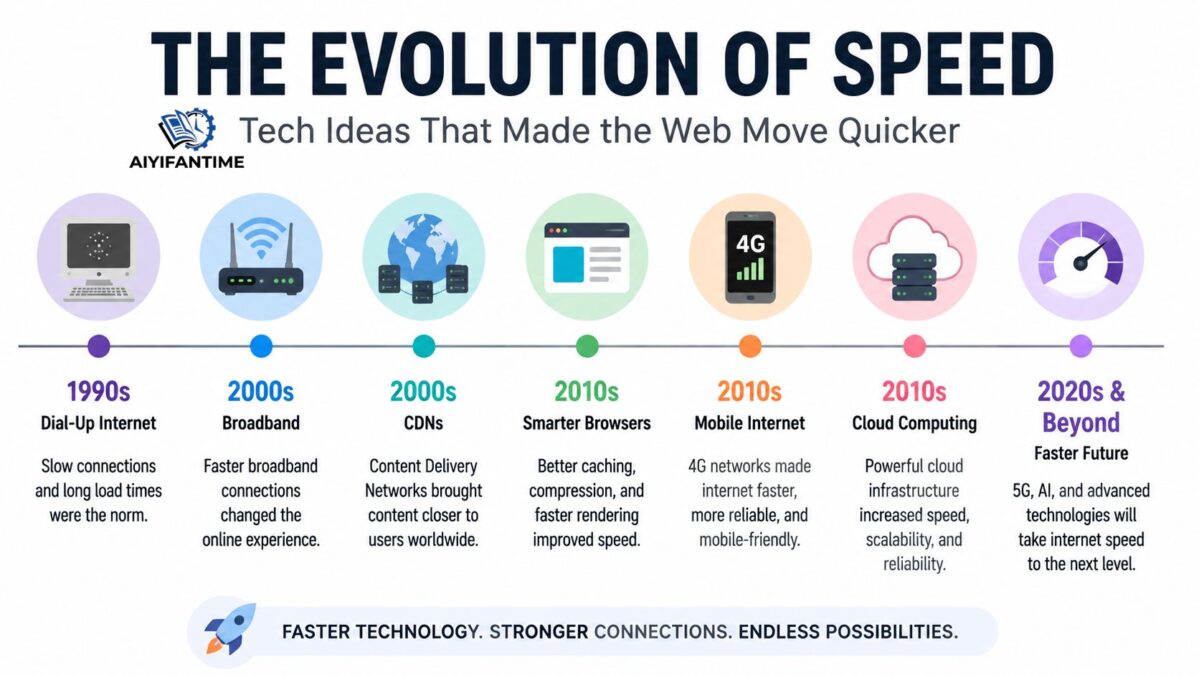

Tech Ideas The internet has transformed from a slow and limited communication network into a lightning-fast digital ecosystem that powers businesses, entertainment, education, and daily life. In the early days of the web, users had to wait several minutes just to load a simple webpage with a few images. Today, high-definition videos stream instantly, cloud gaming works in real time, and websites respond within milliseconds. This incredible transformation did not happen overnight. It was driven by innovative technologies, smart engineering ideas, and continuous improvements in networking and computing systems.
The evolution of Tech Ideas That Made the Web Move Quicker has shaped how people interact with technology. Faster internet has changed communication, online shopping, social media, education, and even healthcare. Every second saved in loading time improves user experience and increases efficiency for businesses and consumers alike. Behind this progress are revolutionary ideas that pushed the boundaries of digital performance and connectivity.
The Beginning of the Slow Internet Era
When the internet first became available to the public in the 1990s, most users relied on dial-up connections. These connections used telephone lines and produced speeds that were extremely slow by modern standards. Downloading a single song or image could take several minutes, while video streaming was nearly impossible.
At that time, websites were simple because internet limitations forced developers to reduce graphics, animations, and multimedia content. Text-heavy pages dominated the web because they loaded faster. Despite the slow speeds, the internet created excitement because it connected people across the world in ways never imagined before.
However, as internet usage increased, there was a growing need for better speed and reliability. This demand encouraged engineers and technology companies to search for innovative solutions that could improve data transmission and reduce delays.
Broadband Technology Revolution
One of the most important breakthroughs in web speed was the introduction of broadband internet. Unlike dial-up, broadband connections allowed users to stay connected continuously while enjoying much faster speeds.
Broadband technologies such as DSL, cable internet, and fiber optics dramatically improved internet performance. Websites loaded faster, downloads became quicker, and online services expanded rapidly. This innovation changed the internet from a basic information-sharing platform into a multimedia-rich environment.
Fiber optic technology became especially revolutionary because it used light signals instead of electrical signals to transmit data. Fiber cables could carry massive amounts of information over long distances with minimal signal loss. This innovation laid the foundation for modern high-speed internet services.
The broadband revolution also accelerated the growth of online businesses, streaming services, and cloud-based applications. Companies realized that faster internet meant better customer experiences and increased engagement.
Content Delivery Networks Changed Everything
As websites became more advanced, companies faced another challenge: delivering content quickly to users across the globe. This led to the creation of Content Delivery Networks, commonly known as CDNs.
CDNs work by storing website data on multiple servers located in different geographic regions. When a user visits a website, the CDN delivers content from the nearest server instead of sending it from a single central location. This reduces latency and speeds up loading times.
This idea transformed the web experience. Large websites and streaming platforms could now handle millions of users simultaneously without major slowdowns. CDNs became essential for online businesses because website speed directly affected customer satisfaction and search engine rankings.
Today, most popular websites rely heavily on CDNs to provide smooth browsing experiences and fast content delivery worldwide.
The Rise of Advanced Web Browsers
Web browsers also played a major role in improving internet speed. Early browsers were limited in functionality and performance, but modern browsers are highly optimized for speed and efficiency.
Companies invested heavily in browser technology to improve rendering engines, caching systems, and resource management. Browsers started loading pages smarter by prioritizing important elements first and reducing unnecessary data processing.
Features like browser caching allowed previously visited websites to load faster by storing temporary data locally on users’ devices. Compression techniques reduced file sizes, enabling faster downloads and quicker page rendering.
Modern browsers also introduced support for faster protocols and advanced security technologies without sacrificing performance. These innovations made the web not only faster but also safer and more reliable.
Mobile Internet and the Need for Speed
The rise of smartphones created a new challenge for internet technology. Users wanted fast web access on mobile devices regardless of location. This demand led to major improvements in wireless networking technologies.
The transition from 2G to 3G, then 4G, and now 5G networks significantly increased mobile internet speeds. Each generation introduced better bandwidth, lower latency, and improved reliability.
4G technology made mobile video streaming and social media usage practical for everyday users. Meanwhile, 5G technology is pushing internet speed to entirely new levels with near-instant response times and support for massive device connectivity.
The development of mobile optimization techniques also became important. Websites were redesigned to load efficiently on smartphones and tablets. Responsive design, image compression, and lightweight coding practices improved mobile browsing experiences dramatically.
Mobile internet advancements transformed how people communicate, work, shop, and consume entertainment, making fast connectivity a global expectation.
Cloud Computing Accelerated the Web
Cloud computing introduced another major shift in internet performance and scalability. Instead of relying on local servers or hardware, businesses could use remote cloud infrastructure to store data and run applications.
Cloud technology improved speed by distributing workloads across powerful global networks. It allowed websites and online services to scale instantly during traffic spikes without crashing or slowing down.
Cloud providers developed highly optimized data centers equipped with advanced networking systems, SSD storage, and intelligent traffic management. These innovations reduced delays and improved service reliability.
Streaming platforms, online collaboration tools, and modern web applications rely heavily on cloud infrastructure to deliver smooth and fast user experiences. Without cloud computing, many of today’s internet services would struggle to handle global demand efficiently.
Data Compression and Optimization Techniques
Another important factor in the evolution of web speed was the development of smarter data compression methods. Compression reduces the size of files before they are transferred over the internet, allowing content to load more quickly.
Technologies like Gzip and Brotli compression became standard for modern websites. Images, videos, and scripts could be compressed significantly without noticeable quality loss.
Developers also adopted optimization strategies such as lazy loading, which loads website content only when needed. This prevents unnecessary data transfer and speeds up initial page loading times.
Minification techniques removed unnecessary spaces and code from files, making websites lighter and faster. These improvements may seem small individually, but together they created major performance gains across the internet.
Faster Internet Protocols and Modern Networking
The protocols that control internet communication have also evolved significantly. Early web communication relied mainly on HTTP, but newer versions like HTTP/2 and HTTP/3 introduced major performance improvements.
HTTP/2 enabled multiple requests to be processed simultaneously through a single connection, reducing delays. HTTP/3 further improved speed and reliability by using advanced transport technologies that minimized latency and packet loss.
DNS optimization also contributed to faster web browsing. Modern DNS systems resolve website addresses more quickly, helping users connect to websites almost instantly.
Additionally, technologies like edge computing brought processing power closer to users. Instead of sending data to distant servers, edge systems process information locally, reducing delays and improving response times.
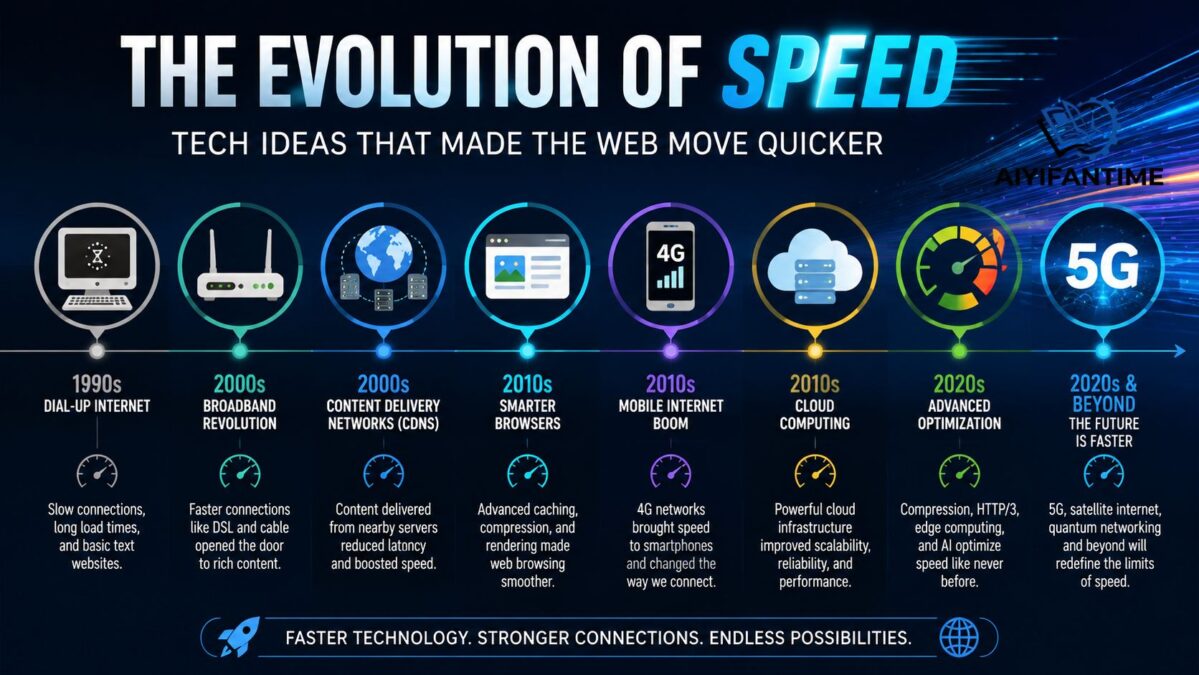
Artificial Intelligence and Smart Performance Management
Artificial Intelligence is now playing an increasingly important role in internet speed optimization. AI-powered systems can analyze traffic patterns, predict congestion, and optimize resource allocation automatically.
Streaming services use AI to adjust video quality dynamically based on internet conditions, ensuring smooth playback even on unstable networks. Search engines use machine learning to deliver faster and more relevant results.
AI-driven network management systems help internet providers detect issues before they affect users. These intelligent technologies improve overall internet efficiency and reduce downtime.
As AI continues to evolve, it is expected to make web services even faster, more personalized, and more efficient.
The Future of Web Speed
The future of internet speed looks incredibly promising. Emerging technologies such as satellite internet, quantum networking, and advanced fiber systems are expected to push connectivity beyond current limits.
Low Earth Orbit satellite networks aim to provide high-speed internet access even in remote areas where traditional infrastructure is unavailable. Quantum communication research may eventually create ultra-secure and ultra-fast data transmission methods.
The growth of smart cities, Internet of Things devices, and virtual reality applications will require even faster and more reliable networks. Future internet systems must support billions of connected devices simultaneously while maintaining low latency and high performance.
Technology companies continue investing billions of dollars into research and infrastructure to create a faster digital future. The internet will likely become even more seamless, responsive, and integrated into daily life.
The early internet relied mainly on dial-up connections that used telephone lines for data transfer. These connections had very limited bandwidth, making websites, downloads, and online communication much slower compared to modern internet standards.
Several technologies improved internet speed over time, including broadband connections, fiber optic cables, Content Delivery Networks (CDNs), cloud computing, and advanced networking protocols like HTTP/2 and HTTP/3.
Broadband internet is a high-speed internet connection that allows continuous access to the web without using traditional dial-up systems. Examples include DSL, cable internet, and fiber optic internet.
Conclusion
The evolution of Tech Ideas That Made the Web Move Quicker is a story of innovation, engineering brilliance, and continuous technological advancement. From slow dial-up connections to ultra-fast fiber networks and intelligent cloud systems, every stage of development has transformed how people experience the internet.
Broadband technology, fiber optics, CDNs, advanced browsers, mobile networks, cloud computing, compression techniques, and AI-powered optimization all contributed to making the web faster and more efficient. These ideas not only improved convenience but also revolutionized industries, communication, education, and entertainment worldwide.
As technology continues to evolve, internet speed will remain a driving force behind digital progress. The future promises even faster connectivity, smarter systems, and new possibilities that will further reshape the online world. The journey of web speed evolution proves that innovation never stops, and the internet’s best days are still ahead.